
Tailoring production management software with nine honest stages
From the moment a kandura is received to the final fitting and delivery, every garment moves through a visible pipeline. The order board always matches the workshop floor — even in the last week of Ramadan.
Received to Completed — the whole workshop on one screen
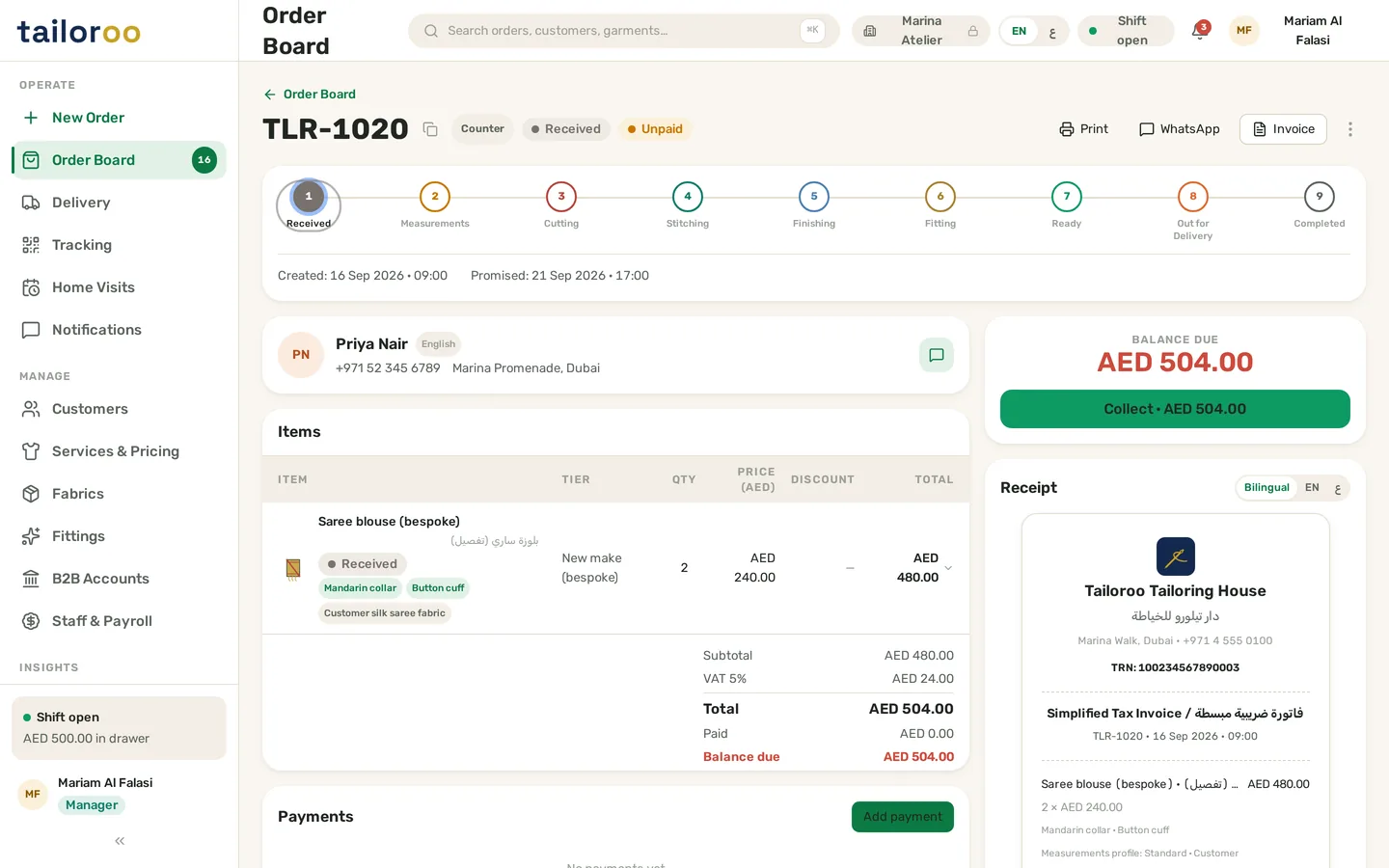
Every order in Tailoroo travels the same pipeline: Received → Measurements → Cutting → Stitching → Finishing → Fitting → Ready → Out for Delivery → Completed. The order detail screen shows the stepper exactly as the workshop sees it, so “where is my sherwani?” is answered at the counter in one look — no phone call to the back room, no guessing from a paper ticket.
Because the stage lives on the garment line, a three-piece order does not have to travel in lockstep. The bespoke kandura can be in Stitching while the trousers wait for a fitting and the alteration shirt is already Ready — and Tailoroo computes the order’s overall stage from those lines automatically.
- Nine fixed stages mirroring a real tailoring workshop
- Order stage computed from garment lines — never set by hand
- Stepper visible on the order screen your cashier already uses
- Works for new-makes and alterations alike, across 14 garment types
A production board that shows the pile-up before it hurts
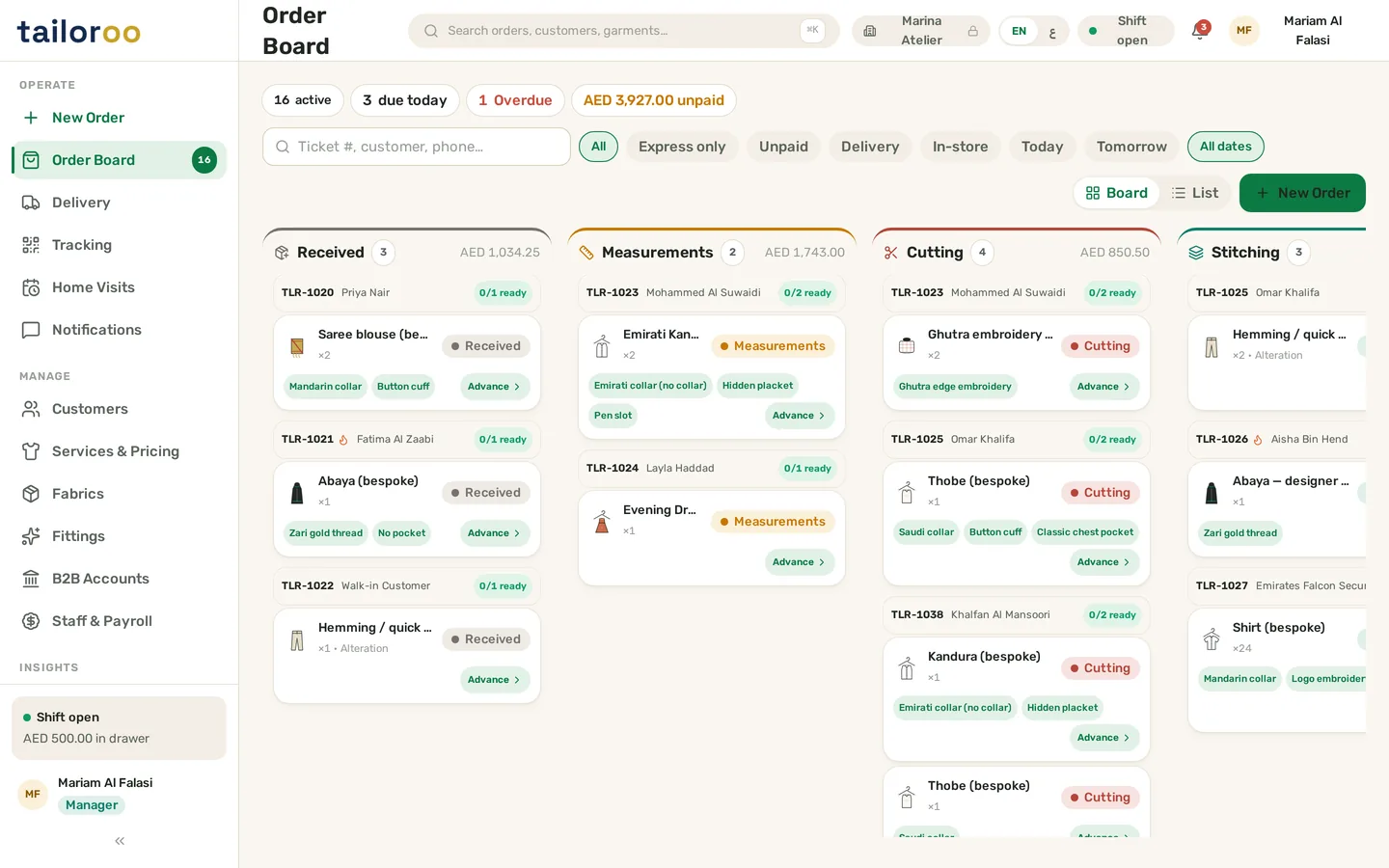
The order board groups every open order by its current stage, so a manager sees the shape of the whole workshop in one glance. Twelve orders stacked in Cutting before Eid? Move a second tailor onto the table today — not when customers start calling. Promised dates sit on every card, so the order that must be ready for a Friday wedding is never quietly buried in the queue.
The same board is what the counter uses to mark work done, so there is no end-of-day reconciliation between the workshop floor and the register — and every stage move lands in the order’s history timeline with a time stamp.
- Orders grouped by stage — bottlenecks visible in seconds
- Promised date and express flag on every card
- Stage moves recorded to a permanent history timeline
- Same live picture for cutter, cashier and owner
What nine stages do for your atelier
Production tracking is built into every Tailoroo plan — no add-on, no extra hardware. Here is what it changes day to day.
Per-garment stages
Each garment line carries its own stage, so a mixed order — abaya, blouse and alteration trousers — moves at the pace of each piece, not the slowest one.
Computed order stage
The order’s status is derived from its garment lines, so the counter never promises “ready” while one piece is still on the stitching table.
Stage history timeline
Every move is time-stamped, from intake to delivery. When a customer disputes a delay, the answer is in the timeline — not in anyone’s memory.
Promised-date tracking
The promised date travels with the order through every stage, so a wedding sherwani due Friday is flagged long before it becomes a Saturday apology.
Express flag
Rush orders keep their express surcharge and priority flag visible at every stage — a same-week kandura never sits unnoticed in the Cutting queue.
Workshop load view
See how much work sits in each stage and pair it with reports & analytics to plan capacity before the pre-Eid and wedding-season surges.
Production workflow FAQ
How does Tailoroo track garments through the workshop?
Can one order contain garments at different stages?
How do I spot a production bottleneck before Eid?
The pipeline works best with the rest of Tailoroo
Production tracking is one part of the Tailoroo system. These are the three features it touches every single day.
Measurements
84 measurement points across 14 GCC-ready templates — captured once, reused on every reorder in the pipeline.
Explore →Fittings & appointments
First and final fittings with WhatsApp reminders, no-show tracking and one-tap reschedule — the Fitting stage, managed.
Explore →Reports & analytics
Stage bottlenecks, turnaround times and per-tailor throughput from live data — before the pre-Eid surge finds them for you.
Explore →Ready to run a smarter tailoring shop?
Book a free demo and see Tailoroo handle orders, measurements, fittings and VAT invoicing for your shop — or explore the live demo yourself.