
Tailoring software vs a generic POS & spreadsheets — an honest comparison
Every tailor in the Emirates runs on one of three things: a notebook, a generic retail POS, or software built for tailoring. Here is where each genuinely fits — and where each quietly fails.
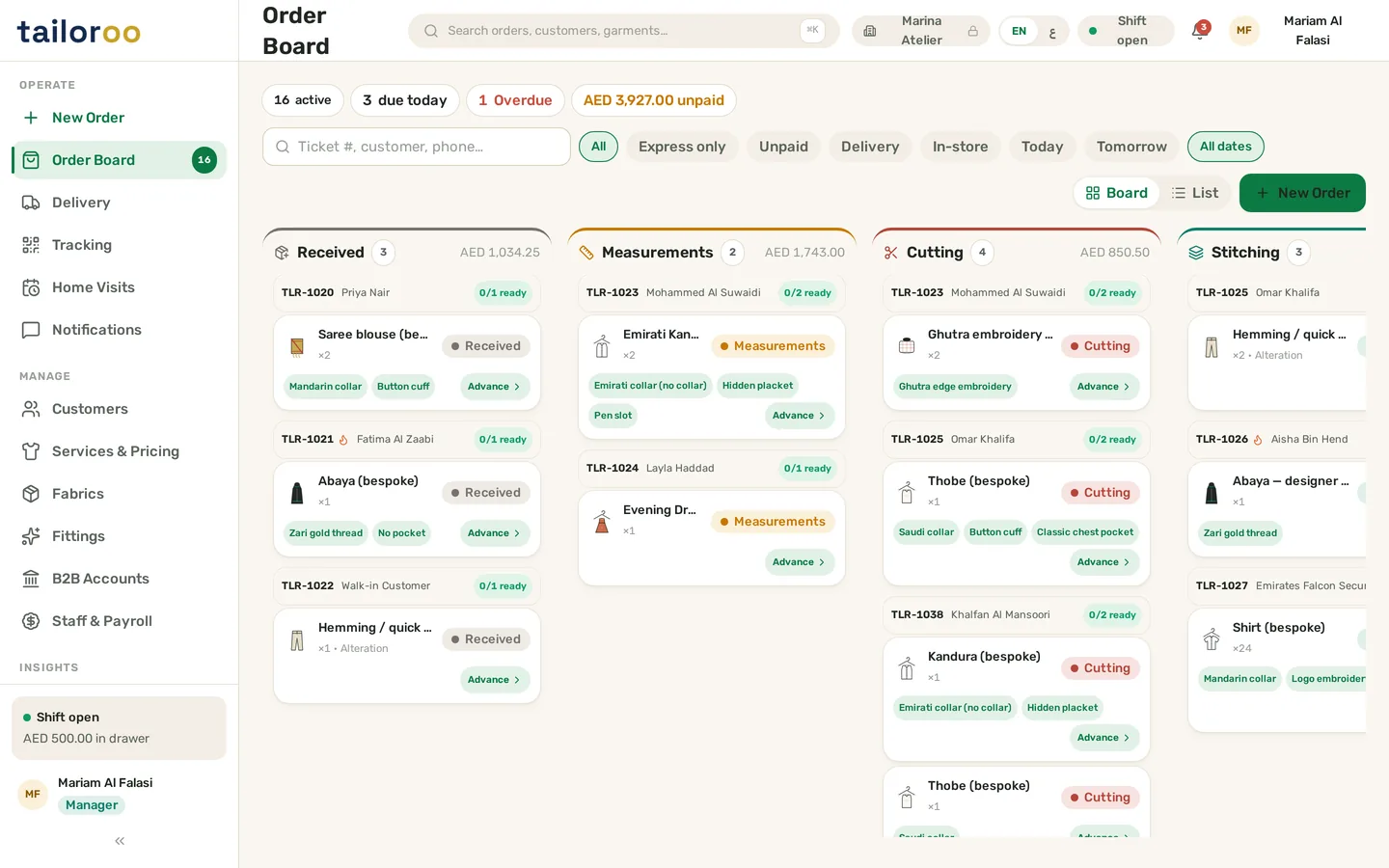
A POS sells things. A tailoring shop makes them.
A generic retail POS is excellent at what it was designed for: scan, charge, receipt, done — the transaction ends at the till. A bespoke order begins at the counter, then lives for weeks as measurements, cutting, stitching, fittings and delivery. No spreadsheet turns a sales register into a production system — which is why generic POS fails tailors once the order book outgrows one person’s memory.
Tailoroo is built by Pandoratech, a UAE software company since 2012, around the way Gulf ateliers actually work — kanduras before Eid, sherwanis in wedding season, customers on WhatsApp, receipts the FTA can inspect. Below is the comparison we would want to read ourselves.
Notebook + Excel vs generic POS vs Tailoroo
The ten capabilities that decide daily life in a tailoring shop.
| What your shop needs | Notebook + Excel | Generic retail POS | Tailoroo |
|---|---|---|---|
| Measurement profiles per customer | A paper notebook; measurements re-taken or hunted for at every reorder. | A notes field at best — no structured measurements, no templates. | 14 templates covering 84 points, stored per customer and pulled into every reorder automatically. |
| Fitting appointments | A wall calendar or memory; no-shows invisible until the customer calls angry. | Not a POS concept — fittings live in a separate diary. | First and final fittings per order, with reminders, no-show tracking and one-tap reschedule. |
| 9-stage production pipeline | Status lives in the master tailor’s head; customers phone to ask. | A sale ends at payment — there is nothing after the receipt. | Nine stages from Received to Completed, computed from the garment lines themselves. |
| Per-garment style options | Sketches and margin notes — easy to misread, impossible to search. | Flat item lines; collar, cuff and embroidery have nowhere to go. | 28 bilingual style options on each garment line, printed on the workshop ticket. |
| Customer’s-own-fabric tracking | A fabric bag with a pinned note, hopefully matched to the right order. | No way to record fabric the customer supplied. | Own-fabric flagged per order line, tracked alongside your shop’s fabric rolls. |
| GCC garment catalog | Prices quoted from memory — and arguments at collection. | A blank item list; every kandura and abaya is yours to build. | A ready bilingual catalog — kandura, thobe, bisht, jalabiya, abaya, suit, sherwani, saree blouse — with new-make and alteration tiers. |
| FTA tax invoices | Handwritten receipts; VAT worked out on a calculator. | Tax settings exist; TRN placement and credit notes are your project. | Compliant FTA tax invoices out of the box: 15-digit TRN, sequential numbering, credit notes. |
| Arabic RTL | Arabic handwriting — until the day shift cannot read the night shift. | English-first; Arabic is a translated label pack, never true right-to-left. | Full Arabic mirroring at a tap — POS, catalog, receipts and notifications. |
| WhatsApp updates | You type every update yourself, one customer at a time. | Email receipts; WhatsApp not built in. | Bilingual WhatsApp messages at every stage — received, fitting time, ready. |
| B2B uniform accounts | A folder of papers, invoiced from memory at month end. | Credit notes, maybe — no contract pricing or consolidated billing. | Contract rate cards and consolidated monthly tax invoices for uniform programs. |
The generic-POS column reflects mainstream retail POS systems sold in the UAE in 2026; products vary. Where the simple option is the right one, we say so below.
Which one fits your shop?
When a generic POS is fine
If you run a pure alterations counter — hems, zips, take-ins at fixed prices, collected within days, no fittings, no delivery — a generic retail POS, or even a tidy notebook and a card machine, will serve you well. With no production pipeline, there is nothing for tailoring software to add. We would rather say that than sell you a subscription you do not need.
When you need tailoring software
The moment orders are made rather than sold: measurements kept per customer, a garment moving through cutting and stitching, a fitting to schedule, fabric the customer brought from the souk, a deposit now and a balance at collection. Add the pre-Eid surge, WhatsApp-first customers and FTA invoices, and the notebook-plus-POS combination starts costing you orders. That is the shop Tailoroo is built for.
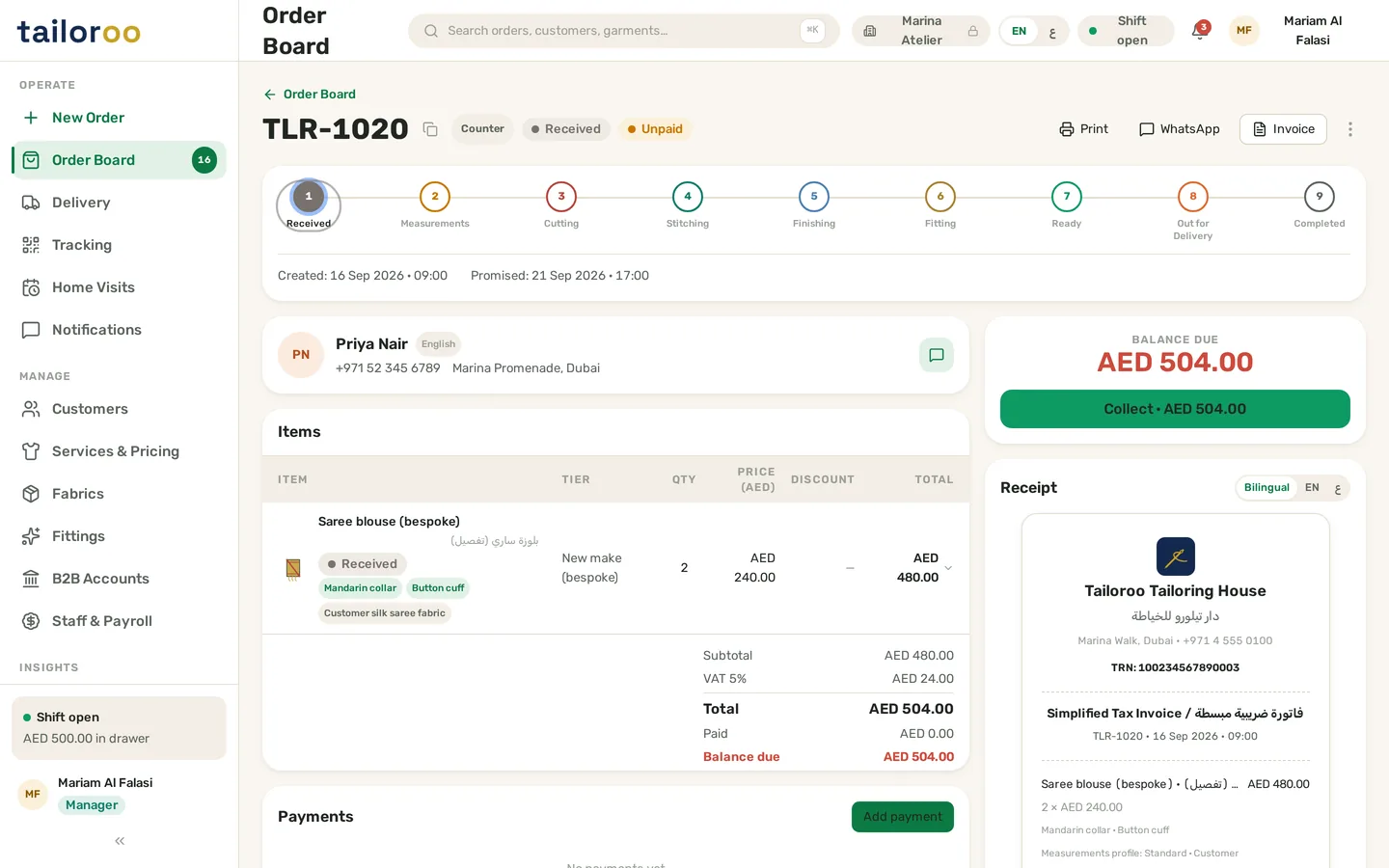
Same counter, calmer shop
Tailoroo does not change how you cut or stitch — it removes the chasing around it. Every piece of the order stays attached from intake to collection:
- Measurement profiles per customer, so reorders start already measured
- A live production board — answer “where is my order?” without calling the workshop
- Fittings & appointments with reminders and no-show tracking
- WhatsApp updates in English or Arabic at every stage
- FTA-compliant VAT invoices with your TRN on every receipt
- B2B & uniform accounts with contract pricing and consolidated monthly invoices
Deciding, answered
We have run on a notebook for twenty years. Why change now?
Can a generic retail POS handle my alteration tickets?
Is moving from Excel and paper to Tailoroo difficult?
Ready to run a smarter tailoring shop?
Book a free demo and see Tailoroo handle orders, measurements, fittings and VAT invoicing for your shop — or explore the live demo yourself.