
Tailoring order management that keeps the atelier moving
Tailoroo’s tailor POS takes every bespoke order from counter intake to final fitting — garment lines with measurements, a live 9-stage production board and every payment in between — in English and Arabic.
A complete bespoke order in under a minute
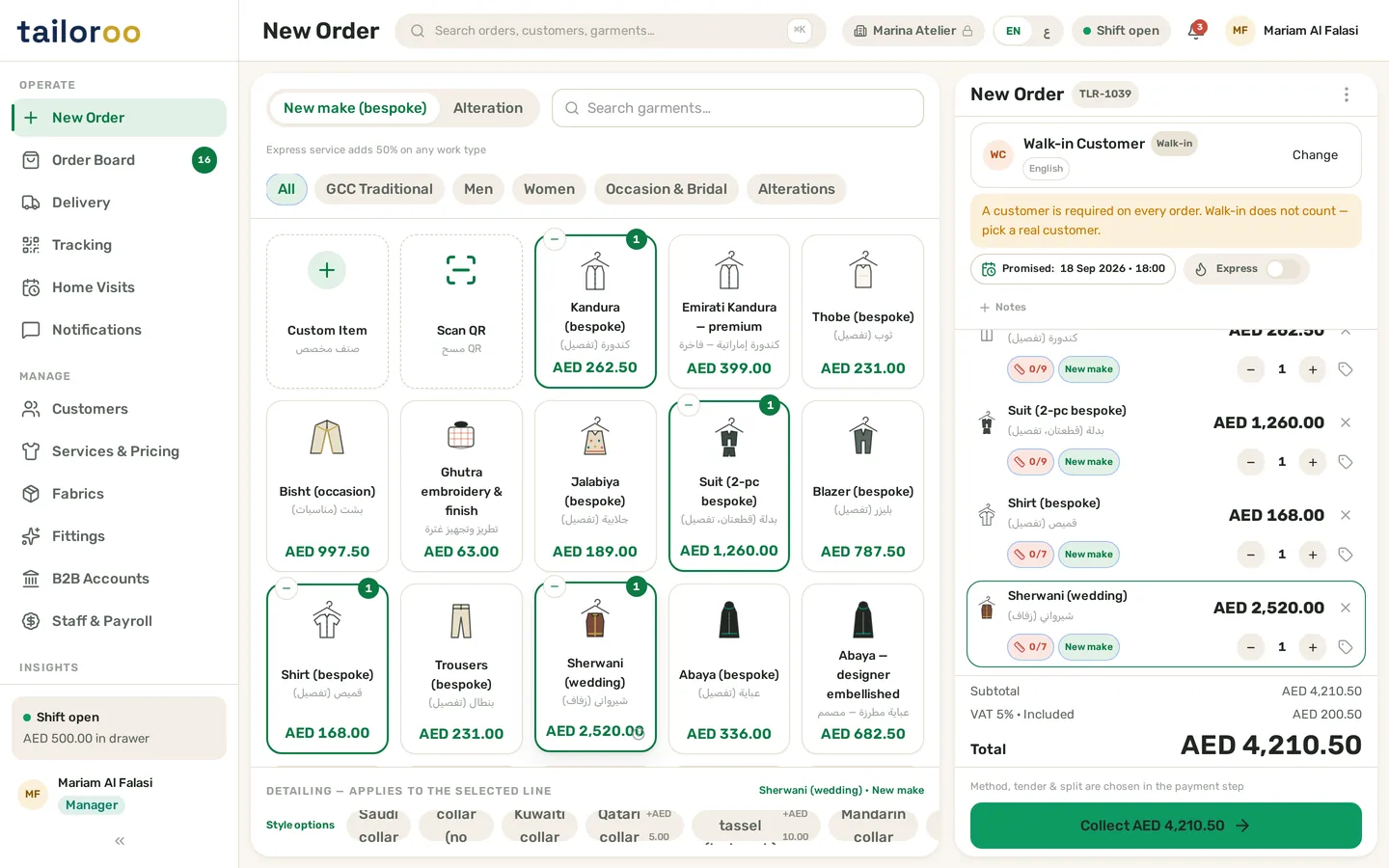
The new-order screen is built for a busy counter: garment tiles on the left, the ticket building live on the right. Tap a bespoke kandura, an Emirati premium cut, a thobe, bisht, jalabiya, abaya, suit or sherwani, pick the tier — new-make or alteration — and the price in AED is already there, VAT included.
- GCC garment tiles out of the box — 14 garment types from kandura and abaya to saree blouse, each with new-make and alteration price tiers
- Style-option chips — collar, cuff, pocket, embroidery — in English & Arabic, noted once at intake and visible to the whole workshop
- Customer’s-own-fabric flag per line, with the customer’s saved measurement profile attached to each garment
- Deposit at intake, balance at collection — and a rush/express toggle that adds the surcharge and stamps the promised date on the ticket
Every garment visible — nothing quietly late
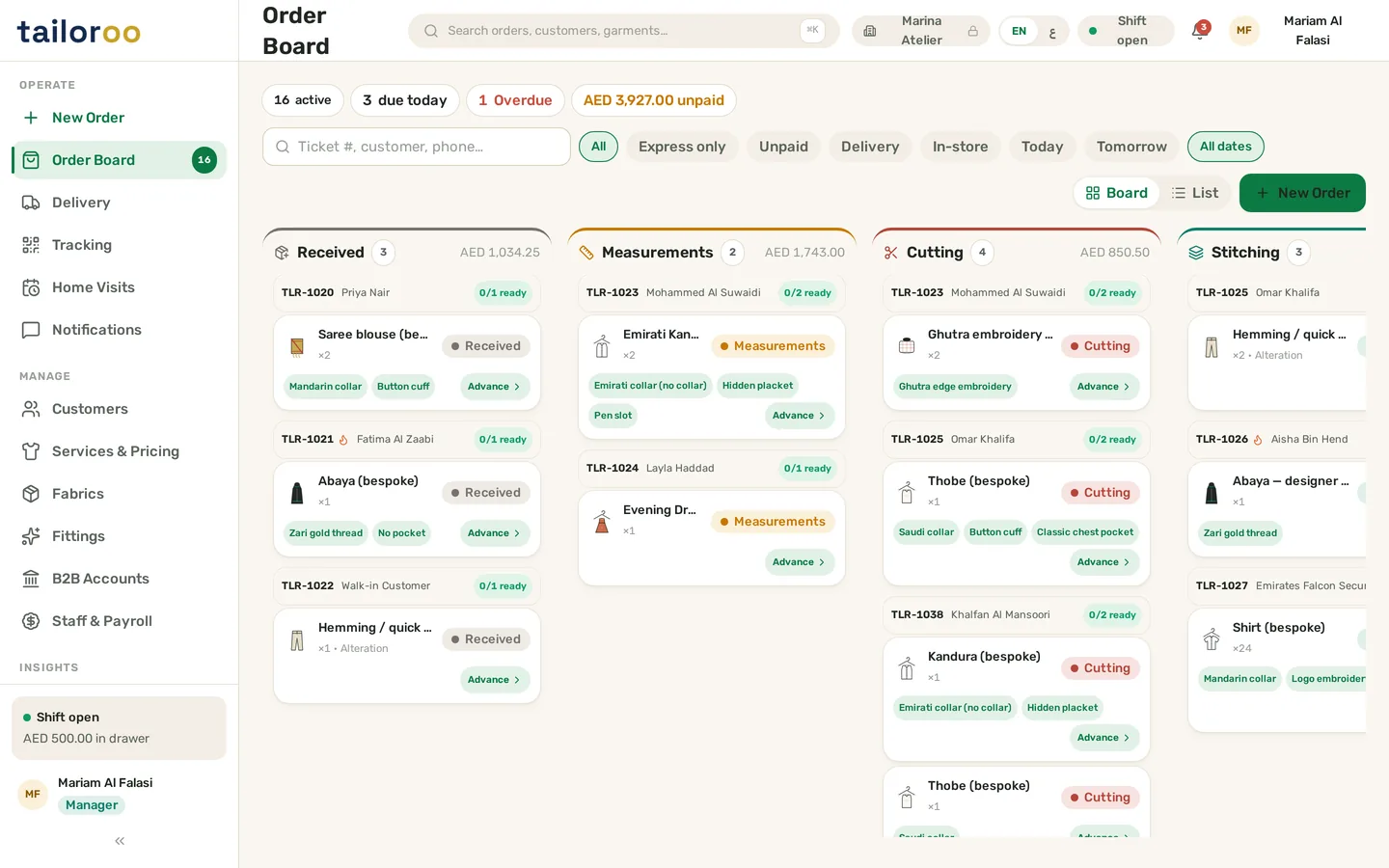
The board is Tailoroo’s home screen, and its columns are your workshop: Received → Measurements → Cutting → Stitching → Finishing → Fitting → Ready → Out for Delivery → Completed. An order’s stage is computed from its garment lines, so the board always reflects the workshop floor — never a stale status someone forgot to update.
- Per-garment stages — the suit can be in Stitching while its shirts are already at Fitting
- Promised dates on every order; overdue work stands out before the customer calls to ask
- Pre-Eid kandura surges and wedding-season sherwanis stay manageable — per-stage counts show the backlog building early
- Ready orders hand straight into final fittings and delivery runs with slot and driver assignment
Small details that save the day
Six quiet capabilities that turn a rushed counter into a calm one — at intake, on the workroom floor and at collection.
Per-garment order lines
A suit and two shirts in one order each carry their own service, price, measurements and stage — the three-piece can sit in Stitching while the shirts are already Ready.
Style options at intake
Collar, cuff, pocket, placket, embroidery — 28 style options as bilingual chips, so the cutter reads exactly what the customer asked for at the counter.
Measurement profile attach
Pull the customer’s saved measurement profile onto each garment line at intake — 84 points across 14 templates, editable on the spot for a reorder with adjustments.
Custom service tile
The unusual commission always arrives — a bridal bisht restoration, a saree blouse from the customer’s own silk. Add a custom service with its own price and note, straight into the ticket.
Per-branch TLR- numbering
Tickets and invoices number sequentially per branch with the TLR- prefix, keeping records clean and FTA-friendly as you grow from one atelier to many.
Walk-in & profile customers
Serve a walk-in alteration in seconds, or attach the order to a saved customer with full history, measurement profiles and on-account terms for regulars.
Order management questions
Can I take a walk-in order without creating a customer profile?
How do deposits and balance payments work?
How do I see which orders are running late?
Works with the rest of Tailoroo
Orders are the core — these features plug straight into the ticket.
Measurements
84 measurement points across 14 GCC-ready templates, saved per customer and reused on every reorder.
Explore →Production workflow
Nine stages from Received to Completed — cutting, stitching, finishing, fitting — always visible.
Explore →WhatsApp notifications
Automatic bilingual updates at every stage — order received, in production, fitting time, ready.
Explore →Ready to run a smarter tailoring shop?
Book a free demo and see Tailoroo handle orders, measurements, fittings and VAT invoicing for your shop — or explore the live demo yourself.